
Fractional Leadership Momentum Continues to Build: Latest Russam Survey Shows Growing Confidence
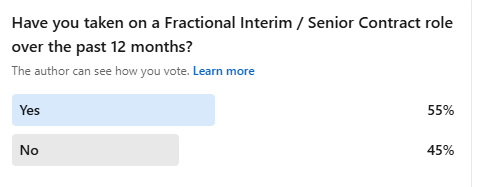
The conversation around fractional leadership has moved well beyond theory and being a fad. Recent polling within the Russam interim and executive community shows significant growth in one year, with 55% of Russam Interim Executives saying they have taken on a Fractional role in the past 12 months – up from 46% in June 2025. This could be alongside a more “traditional” interim role but the growth of executives doing 1-2 days per week is one to look at seriously; we now estimate that 25% of our 27,900 Interim community is working on a fractional basis. For a leadership model that was still considered niche only a few years ago, this represents a significant shift in both awareness and adoption.
A Market That Has Changed Rapidly
The growth of fractional leadership has been remarkable; and fractional or portfolio executives now represent a significant structural change in the market, allowing professionals to balance multiple clients simultaneously. Industry estimates suggest that the number of UK LinkedIn profiles referencing “fractional leadership” has increased from around 2,000 in 2022 to well over 140,000 today. At Russam, we are now seeing almost as many fractional assignments as traditional interim assignments.
The demand is no longer limited to fractional CFOs or HR leaders. Organisations are increasingly seeking fractional CEOs, Commercial Directors, Operations Directors and transformation specialists who can provide strategic leadership without the commitment of a full-time executive hire.
In fact, this week alone we were approached by an international payments solutions business seeking a two-day-per-week CEO alongside a one-day-per-week CFO.
Why Organisations Are Embracing Fractional Leadership
Several forces are driving this growth.
1. Cost and Flexibility – Businesses face continued pressure to control costs while maintaining access to high-calibre leadership talent. Fractional appointments allow organisations to secure senior expertise without the financial commitment and employment obligations associated with permanent executive hires.
2. Faster Access to Expertise – Companies increasingly require specialist leadership capability immediately. Whether the challenge relates to growth, AI adoption, fundraising, compliance, operational improvement or market expansion, fractional leaders can often begin creating value quickly.
3. Skills Shortages at Senior Level – Many organisations simply cannot justify a full-time executive in specialist disciplines. Fractional leadership provides access to expertise that may otherwise be unavailable.
4. Changing Executive Preferences – Senior leaders themselves are increasingly attracted to portfolio careers, combining multiple assignments, sectors and challenges rather than committing to a single organisation.
5. Hybrid and Remote Working – The widespread acceptance of hybrid working has made part-time executive leadership far more practical. Businesses are increasingly comfortable with outcome-based leadership rather than measuring executive contribution through physical presence.
Fractional and Interim: Different Models, Different Outcomes
One theme that emerged strongly from recent discussions within the interim community is the growing distinction between fractional leadership and traditional interim management. While both models provide organisations with experienced independent executives, they are increasingly serving different needs.
Fractional Leadership
Typically:
- Longer-term engagements
- Part-time commitment
- Strong strategic focus
- Board advisory and growth-oriented support
- Common within SMEs, scale-ups and founder-led businesses
Fractional leaders often help organisations shape direction, strengthen capability and transfer knowledge into the existing management team.
Interim Management
Typically:
- Shorter-term assignments
- Full-time or near full-time commitment
- Delivery and execution focused
- Transformation, restructuring or crisis management
- Greater operational accountability
Interims are usually brought in to solve urgent challenges, lead significant change programmes or provide immediate leadership cover. For this reason, many professionals increasingly view fractional leadership as a distinct category rather than simply a subset of interim management.
Watch the Discussion
Russam recently hosted a discussion with Oliver Law, Fractional CEO and transformation specialist, exploring the evolution of fractional leadership, how the market is developing, and the opportunities it creates for both organisations and executives.
Fractional Leadership, Interim Management or Full-Time Executive Role
If your organisation is reviewing its leadership structure, planning growth, navigating change or considering whether a fractional, interim or blended approach could deliver greater value, our team would be delighted to help.
Contact Russam for a confidential discussion about your requirements.
Contact us
Call us on 07930 356305 or email HQ@russam.co.uk